
CODE 013: OSHA Industrial Hygiene
Home / Training
Duration: 1 day
Modules:
Sectors: All Industries
Number of Certificate: 1 Assessment & Certificate
Course Fee
- FREE access trial
- $29 PDF & Original Certificates
- $20 PDF Certificates
Shipping & Handling not included for original certificates

Program Overview
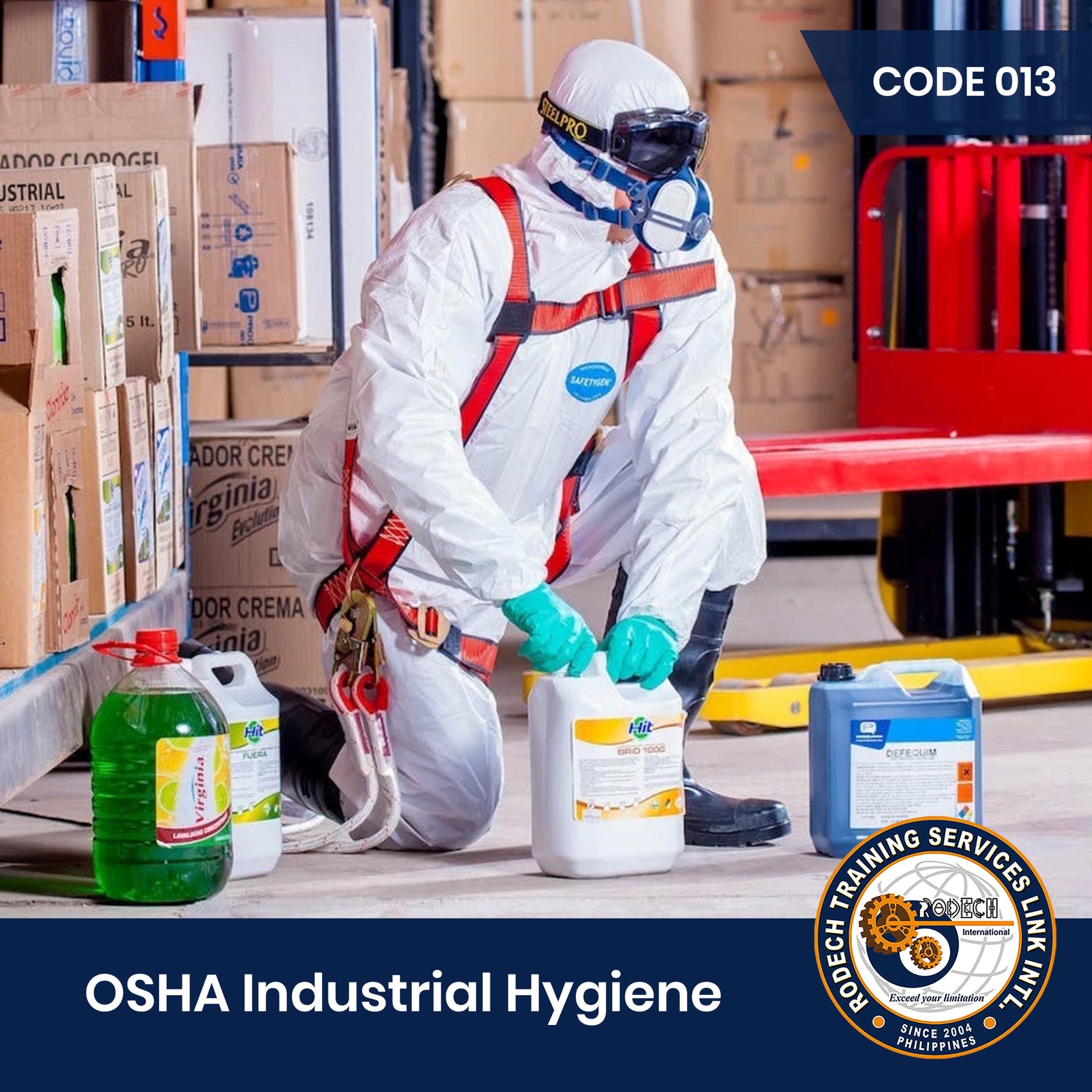
Industrial hygiene focuses on protecting workers from chemical, physical, biological, and ergonomic hazards by anticipating, recognizing, evaluating, and controlling exposures. A strong course blends regulatory knowledge with hands-on field techniques so participants can confidently assess real environments such as workshops, schools, mechanical rooms, fabrication shops, and confined spaces.
Course Objectives
Participants should be able to:
- Explain the purpose and scope of industrial hygiene, including regulatory foundations (OSHA, ACGIH TLVs, NIOSH RELs, ISO standards).
- Identify major workplace hazards across chemical, physical, biological, and ergonomic categories.
- Evaluate exposures using air sampling, noise monitoring, ventilation assessment, and walkthrough surveys.
- Apply the hierarchy of controls to reduce or eliminate hazards.
- Interpret exposure limits such as TWA, STEL, and ceiling values.
- Develop basic IH documentation, including sampling logs, exposure assessments, and corrective action plans.
- Integrate IH principles into daily operations, maintenance work, and emergency response.
Key Features of a Strong IH Course
- Regulatory grounding so workers understand compliance requirements.
- Hands-on demonstrations using pumps, detectors, airflow meters, and noise dosimeters.
- Scenario-based learning that mirrors real job sites (e.g., welding fumes, HVAC mechanical rooms, chemical storage).
- Cross-disciplinary integration with safety programs like confined space, lockout/tagout, and ventilation.
- Practical tools and checklists for field use.
- Exposure assessment exercises that build confidence in measurement and interpretation.
- Emphasis on engineering controls, especially ventilation and isolation—areas where your HVAC and machine-guarding experience is valuable.
Course Modules:
- Introduction to Industrial Hygiene
- Definition and purpose of IH.
- Anticipation, recognition, evaluation, and control framework.
- Regulatory bodies and exposure limits.
- Routes of exposure and health effects.
- Chemical Hazard Recognition and Control
- Types of chemical hazards: gases, vapors, particulates, solvents, corrosives.
- Exposure limits: TLV-TWA, STEL, ceiling.
- Air sampling methods: personal, area, direct-reading instruments.
- Engineering controls: local exhaust ventilation, substitution, containment.
- PPE selection and limitations.
- Physical Hazards
- Noise: decibel scales, hearing conservation, dosimetry.
- Heat and cold stress: WBGT, hydration, acclimatization.
- Radiation: ionizing vs non-ionizing, shielding principles.
- Vibration: hand-arm and whole-body exposure.
- Biological Hazards
- Pathogens: bacteria, viruses, fungi, allergens.
- Exposure pathways in schools, hospitals, and maintenance environments.
- Controls: sanitation, ventilation, PPE, administrative measures.
- Ergonomic Hazards
- Risk factors: force, repetition, posture, vibration.
- Assessment tools: REBA, RULA, NIOSH lifting equation.
- Controls: workstation design, mechanical aids, job rotation.
- Exposure Evaluation Techniques
- Walkthrough surveys and hazard recognition checklists.
- Air monitoring equipment and calibration.
- Ventilation assessment: airflow measurement, smoke tests, HVAC performance.
- Noise mapping and dosimetry.
- Surface sampling for lead, asbestos, and biological contaminants.
- Control Strategies and Program Development
- Hierarchy of controls in practice.
- Engineering vs administrative controls.
- Respiratory protection programs and fit testing.
- Emergency response for chemical releases, spills, and confined spaces.
- Documentation and Reporting
- Exposure assessment reports.
- Sampling logs and calibration records.
- Corrective action plans.
- Communication of findings to workers and management.
- Practical Scenarios and Case Studies
- Welding fumes in fabrication shops.
- Heat stress for rooftop HVAC technicians.
- Mold and IAQ issues in schools.
- Chemical storage and mixing hazards.
- Noise exposure in machine shops.
Additional Layer: How This Course Supports Real-World Safety Work
A well-designed IH course strengthens:
- Risk assessment skills for maintenance and technical staff.
- Decision-making when selecting controls or recommending improvements.
- Coordination with other safety programs like confined space, LOTO, and emergency response.
- Training capability, especially when you’re guiding apprentices or coworkers.