
CODE-005: OSHA Confined Spaces Training for Competent and Qualified Person
Home / Training

Duration: 1 day
Modules: 13
Sectors: All Industries
Number of Certificate: 1 Assessement & Certification
Course Fee
- FREE access RVU
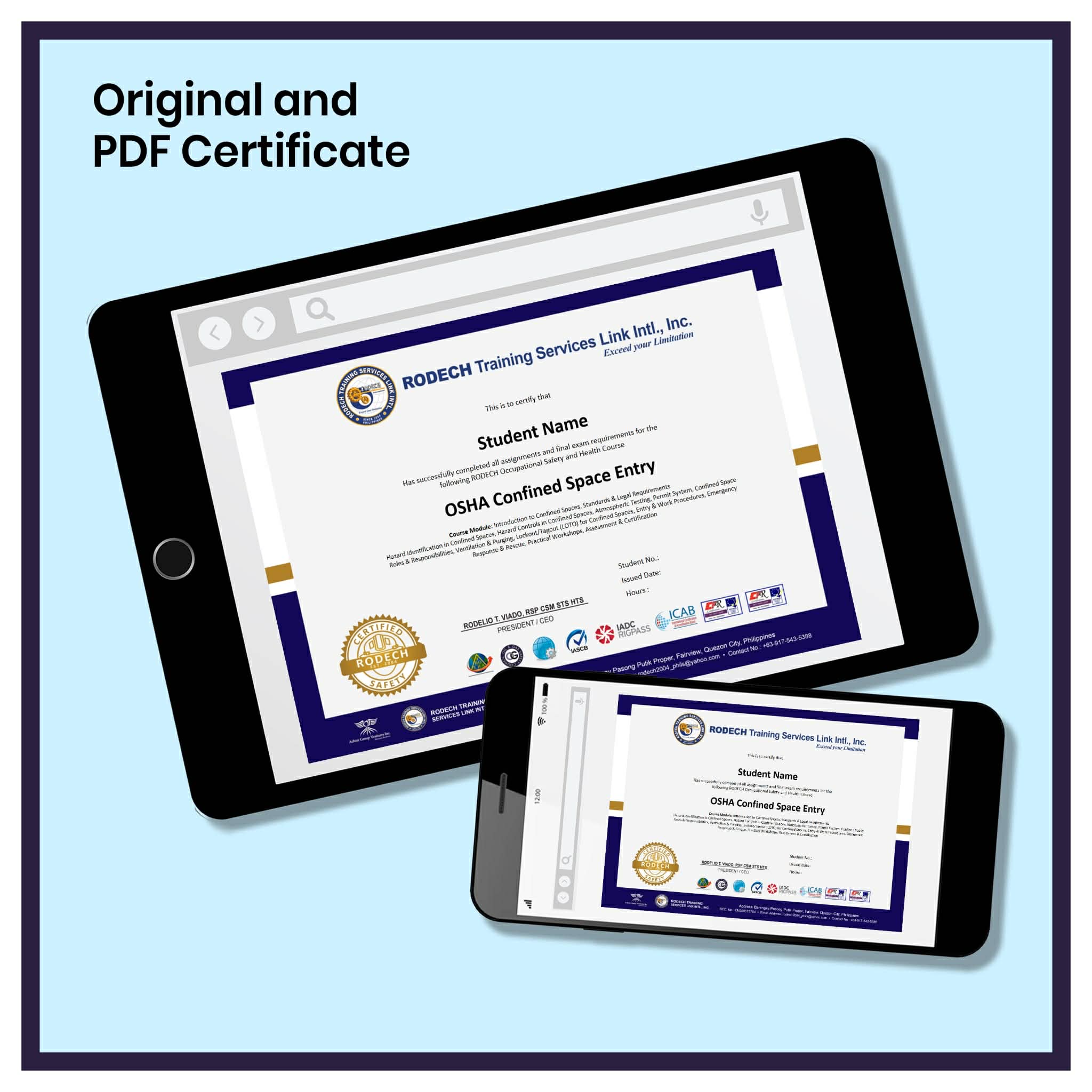
- $120 PDF & Original Certificates
- $85 PDF Certificates
Shipping & Handling not included for original certificates
Program Overview:
The OSHA Confined Space Entry Course for Competent Person is designed to provide participants with the knowledge, skills, and authority required to safely manage confined space operations, in accordance with OSHA 29 CFR 1910.146 (Permit-Required Confined Spaces) and applicable construction standards (29 CFR 1926 Subpart AA).
This course focuses on the roles and responsibilities of:
- Entry Supervisor
- Authorized Entrant
- Attendant
Participants will learn how to identify confined space hazards, implement control measures, conduct atmospheric testing, and ensure safe entry, work, and exit procedures.
The training emphasizes hazard recognition, permit systems, emergency preparedness, and rescue planning, ensuring participants can effectively protect workers from life-threatening conditions such as oxygen deficiency, toxic gases, and engulfment.
Objectives:
1. Understand OSHA Confined Space Regulations
- Interpret OSHA standards:
- 29 CFR 1910.146 (General Industry)
- 29 CFR 1926 Subpart AA (Construction)
- Define:
- Confined space
- Permit-required confined space (PRCS)
- Identify employer and worker responsibilities
2. Define Key Roles and Responsibilities
Entry Supervisor
- Authorize and verify safe entry
- Ensure permits are completed correctly
- Confirm hazard controls are in place
- Terminate entry when unsafe conditions arise
Authorized Entrant
- Safely enter and perform assigned tasks
- Monitor conditions inside the space
- Use required PPE and equipment
- Exit immediately when hazards are detected
Attendant
- Remain outside the confined space
- Monitor entrants continuously
- Maintain communication
- Initiate emergency response if needed
- Prevent unauthorized entry
3. Identify Confined Space Hazards
- Oxygen deficiency or enrichment
- Toxic gases (H₂S, CO, etc.)
- Flammable or explosive atmospheres
- Engulfment hazards (liquids, sand, grain)
- Mechanical and electrical hazards
- Heat stress and physical hazards
4. Perform Hazard Assessment and Risk Control
- Conduct Job Hazard Analysis (JHA)
- Classify confined spaces (permit vs non-permit)
- Apply the hierarchy of controls:
- Elimination
- Engineering controls (ventilation, isolation)
- Administrative controls
- PPE
5. Implement Permit-Required Confined Space System
- Understand and complete entry permits
- Verify:
- Atmospheric testing results
- Isolation of energy sources (LOTO)
- Ventilation requirements
- Maintain documentation and authorization
6. Conduct Atmospheric Testing and Monitoring
- Use gas detectors properly
- Test for:
- Oxygen level (19.5%–23.5%)
- Flammable gases (LEL)
- Toxic gases
- Perform continuous monitoring
7. Apply Safe Entry and Work Procedures
- Pre-entry planning and briefing
- Lockout/Tagout (LOTO)
- Ventilation and purging
- Safe access and egress
- Communication systems
8. Use Personal Protective Equipment (PPE)
- Respiratory protection
- Harness and lifelines
- Protective clothing
- Gas detectors and alarms
9. Develop Emergency and Rescue Plans
- Non-entry rescue procedures (preferred)
- Entry rescue requirements
- Rescue team roles and equipment
- Emergency communication and response
- Awareness of suspension trauma
10. Exercise Authority as a Competent Person
- Identify and correct unsafe conditions
- Stop work when hazards are present
- Ensure compliance with entry procedures
- Remove personnel from danger
Course Modules
Module 1: Introduction to Confined Space Safety
- Definition of confined space and permit-required confined space (PRCS)
- OSHA standards overview (29 CFR 1910.146 & 1926 Subpart AA)
- Importance of confined space safety
- Accident statistics and case studies
Module 2: Roles and Responsibilities
- Competent Person definition
- Entry Supervisor duties
- Authorized Entrant responsibilities
- Attendant responsibilities
- Communication and coordination
Module 3: Identification of Confined Spaces
- Characteristics of confined spaces:
- Limited entry/exit
- Not designed for continuous occupancy
- Types of confined spaces (tanks, silos, manholes, pits, etc.)
- Permit vs Non-permit confined spaces
Module 4: Hazard Identification
- Atmospheric hazards:
- Oxygen deficiency/enrichment
- Toxic gases (H₂S, CO)
- Flammable gases (LEL)
- Physical hazards:
- Engulfment
- Mechanical hazards
- Electrical hazards
- Heat stress and noise
Module 5: Hazard Assessment & Control
- Job Hazard Analysis (JHA)
- Risk assessment process
- Hierarchy of controls:
- Elimination
- Engineering controls (ventilation, isolation)
- Administrative controls
- PPE
Module 6: Permit-Required Confined Space System
- Entry permit requirements
- Completing and authorizing permits
- Isolation methods (LOTO, blanking, blinding)
- Permit validation and duration
Module 7: Atmospheric Testing and Monitoring
- Gas detection equipment
- Testing sequence: Oxygen → Flammable → Toxic gases
- Acceptable limits: Oxygen: 19.5%–23.5%
- Continuous monitoring procedures
Module 8: Ventilation and Control Measures
- Types of ventilation:
- Natural
- Mechanical (forced air)
- Purging and inerting
- Maintaining safe atmosphere
Module 9: Personal Protective Equipment (PPE)
- Respiratory protection
- Full body harness and lifelines
- Protective clothing
- Gas monitors and alarms
Module 10: Safe Entry and Work Procedures
- Pre-entry briefing
- Isolation and lockout/tagout (LOTO)
- Safe access and egress
- Communication systems
- Work practices inside confined spaces
Module 11: Emergency Response and Rescue
- Types of rescue:
- Non-entry rescue (preferred)
- Entry rescue
- Rescue equipment: Tripods, winches
- Emergency procedures and communication
- Suspension trauma awareness
Module 12: Inspection, Monitoring, and Documentation
- Pre-entry checks
- Ongoing monitoring
- Permit documentation
- Incident reporting
Module 13: Practical Training / Workshop
- Confined space identification exercise
- Permit completion exercise
- Gas detector demonstration
- Hazard identification scenarios
- Role-playing (Entrant, Attendant, Supervisor)
Module 14: Assessment and Certification
- Written examination (MCQs)
- Practical assessment